7 Types of Autumn Leaves That Block Perth Gutters Most
- 6 days ago
- 9 min read

Perth's autumn may not deliver the dramatic colour displays of the eastern states, but it creates one of the most critical maintenance windows for property owners across the metropolitan area. From March through June, gutters accumulate autumn gutter leaves from a wide range of species - each one behaving differently and creating a distinct blockage challenge.
Most Perth homeowners think about gutter problems when overflow is already visible. That's usually too late. The autumn leaf accumulation that sits quietly in dry gutters through March and April doesn't cause obvious problems until Perth's winter rains arrive in June or July - then it causes them all at once.
Understanding which tree species create the most serious blockage risks helps property owners time their maintenance correctly and prioritise the trees closest to their rooflines. The seven leaf types covered below account for the majority of serious autumn blockages across Perth's residential suburbs. Each behaves differently, and each requires specific timing to address effectively.
Perth's Autumn Leaf Challenge and Why Leaf Type Matters
Why Perth's Autumn Is Still a High-Risk Period
Perth's Mediterranean climate means autumn runs from March through May with predominantly dry conditions. Unlike eastern states where autumn rain helps flush leaves through drainage systems, Perth's dry autumn allows debris to accumulate undisturbed through the entire leaf-fall period.
Leaves that arrive in gutters during March sit through weeks of dry weather, compacting and drying without flushing. By the time the first significant winter rain arrives in June or July, months of accumulation have formed dense blockages that are far more severe than they would have been if rainfall had been occurring throughout the period.
Autumn gutter cleaning Perth homeowners consistently defer is one of the most common and costly maintenance mistakes across the metro area. A clean in April or May, after the main leaf-fall window but before winter rains, provides the most effective protection for drainage systems during Perth's wettest months.
How Leaf Type Determines Blockage Risk
Leaf type determines blockage severity more than leaf volume. A small number of large plane tree leaves creates more immediate obstruction than a large volume of small jacaranda leaflets. The oil content in eucalyptus leaves causes mat formation that other species don't replicate. Oak leaves resist decomposition and stain gutter surfaces. Liquidambars arrive all at once rather than gradually.
Proflo has cleared autumn gutter leaves from Perth properties for over 33 years. Their technicians observe every tree species common to WA suburbs and the distinct blockage patterns each creates - knowledge that directly informs the maintenance schedules they recommend for different property types.
The 7 Leaf Types Blocking Perth Gutters Most
1. Eucalyptus Leaves - The Year-Round Accumulator
Eucalyptus leaves are Perth's most persistent gutter challenge. These leaves contain natural oils that cause them to clump when wet, forming waterproof mats that completely block water flow across gutter lengths. Unlike deciduous species that concentrate their drop into a defined autumn window, eucalypts shed year-round - meaning gutters beneath them never have a recovery period.
Autumn increases eucalyptus shedding, but summer and spring also contribute significant material. By the time autumn leaf cleaning is due, properties with large gum trees are already carrying months of accumulated bark strips, gumnuts, and leaf mats. The combination creates dense, layered blockages that resist standard flushing.
Prolonged eucalyptus mat accumulation also contributes to gutter fascia damage. Moisture trapped behind waterproof leaf mats sits against fascia boards continuously, accelerating timber deterioration and paint failure. Professional gutter cleaning services using vacuum extraction remove eucalyptus mats completely - bark, gumnuts, and compacted leaves in a single pass that manual clearing misses.
2. Jacaranda Leaflets - The Fine Mesh Maker
Jacaranda trees create two distinct maintenance problems. During October and November, flowers fall in large volumes and decompose into sticky purple sludge that coats gutter interiors. Then, from late May through June, leaves drop and create a second accumulation wave. Properties with mature jacarandas need targeted cleaning to address both periods.
The leaves are compound, meaning each leaf separates into dozens of small leaflets when it falls. These leaflets are small enough to wash through some gutter mesh guards and large enough to create filter-like blockages in gutter channels. The mesh they form catches every additional piece of debris that lands in the gutter, accelerating blockage formation. Jacaranda gutter debris that includes decomposed flower residue from the preceding spring creates particularly adhesive material that binds leaflet accumulations together.
3. Liquidambar Leaves - The Dense Mat Maker
Liquidambar trees were planted extensively across Perth suburbs from the 1970s through 1990s. Their spectacular star-shaped leaves create one of Perth's most challenging autumn blockage scenarios. A mature liquidambar can drop its entire canopy within two to three weeks, creating a sudden avalanche of broad, flat leaves that stack into dense, drainage-blocking layers.
The timing is critical. Perth liquidambars typically complete leaf drop between late April and early May - often just weeks before the first significant winter rain. This compressed window leaves little time for cleaning between the completion of leaf fall and the arrival of the rain that will test the drainage system. Liquidambar gutter blockage is particularly dangerous because the volume arrives suddenly rather than gradually, giving property owners less warning than species that shed progressively.
As liquidambar leaves decompose, they form sludge that becomes increasingly difficult to remove with time. Fresh material extracts cleanly. Material that has sat for four to six weeks requires significantly more effort and cost to clear effectively.
4. Plane Tree Leaves - The Size Champions
Plane trees grow in older Perth suburbs, particularly around heritage properties in suburbs like Subiaco, Mount Lawley, and Shenton Park. They are deciduous trees that drop enormous leaves - some reaching 25 centimetres across. A single leaf can cover an entire section of gutter from front to back.
Large plane tree leaves don't wash through drainage systems easily. They catch on gutter brackets, screws, and rough surfaces, creating physical dams that trap smaller debris behind them. Within days of leaf fall, a relatively small number of leaves can create complete blockages across multiple gutter sections.
The thick, woody stems attached to plane tree leaves present an additional problem. The stems don't decompose readily and create anchor points where other debris accumulates. They also wedge into downpipe openings with enough rigidity to resist normal water pressure. Gutter fascia damage from the weight stress of compacted plane tree leaf accumulation has been observed across many older Perth properties where cleaning is deferred through the full autumn period.
5. Peppercorn Tree Leaves - The Fine Mesh Creator
Peppercorn trees (Schinus molle) are a common feature in older Perth gardens and streetscapes. They are evergreen but increase leaf drop during autumn. Their small, compound leaves create fine mesh-like accumulation in gutters that acts as a filter, trapping every subsequent piece of debris.
The leaves contain aromatic oils that cause them to stick together when wet, forming dense clumps that water cannot penetrate. Standard flushing compresses peppercorn leaf accumulation rather than clearing it. The pink berries these trees drop during autumn compound the problem - berries mix with leaves to create sticky masses that bond to gutter interiors and accelerate blockage formation.
Properties with established peppercorn trees benefit from late-May cleaning that captures the bulk of autumn leaf and berry fall before winter rains begin.
6. Oak Leaves - The Slow Decomposers
Oak trees aren't native to Perth but many mature specimens grow in established suburbs across the metro area. They are deciduous trees that drop leaves late - typically May through June - extending Perth's autumn leaf challenge directly into the winter rain window.
Oak leaves contain high levels of tannins that leach out as they decompose, staining gutter surfaces, fascia boards, and exterior walls. These stains are difficult to remove and can permanently discolour painted gutter systems. The leaves themselves are tough and leathery, resisting decomposition for extended periods. Autumn gutter leaves from oak trees can sit intact through an entire Perth winter before breaking down, creating persistent blockages across the wettest months of the year.
Acorns present a separate problem. These hard, solid nuts roll into downpipes and create physical blockages that water cannot shift. Even a small number of acorns at a downpipe junction stops drainage flow entirely.
7. Deciduous Leaf Combinations - The Compounded Risk
Many Perth properties with established gardens have multiple deciduous species. Liquidambar gutter blockage material compounds with plane tree leaves. Jacaranda gutter debris from spring flower drop mixes with autumn leaf fall. Oak tannins stain surfaces already coated with eucalyptus mat residue.
Mixed deciduous leaf types create layered blockages with different densities at different depths in the gutter channel. This layering makes partial cleaning particularly ineffective - removing surface material leaves compacted lower layers that continue blocking drainage. Gutter fascia damage compounds across properties with multiple tree types when maintenance is deferred, because moisture is trapped continuously by different debris layers rather than from a single episode.
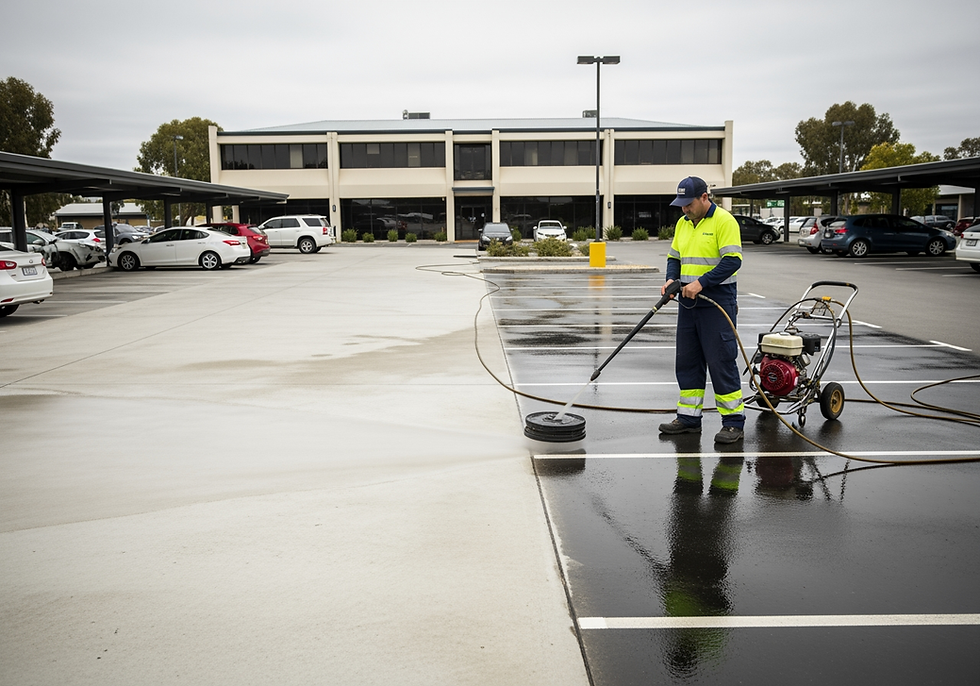
Pressure washing services address exterior staining on walls, driveways, and paths caused by overflow from mixed-leaf autumn blockages. Tannin and flower sludge stains from compounded autumn gutter debris are best addressed promptly before they bond to exterior surfaces permanently.
How Perth's Climate Intensifies Autumn Leaf Risks
The Dry Autumn Effect
Perth's March to May autumn is characterised by predominantly dry conditions. This means debris that falls into gutters during autumn stays there, drying progressively without the natural flushing that rainfall provides in more temperate climates. By the time winter rains arrive, months of accumulated and compacted material has reached maximum blockage density.
Autumn gutter leaves that dry completely during Perth's late-autumn dry spell also become fire-hazard material heading into summer. Deciduous leaf gutter cleaning Perth homeowners complete in May removes this potential fuel load months before summer heat peaks and ember attack risk arrives in December - a benefit that extends well beyond the immediate winter protection window.
The Winter Rain Timing Problem
Perth's winter storms often arrive as intense downpours rather than gradual rain. When these events hit gutters carrying full autumn leaf loads, overflow is immediate. Compacted autumn debris absorbs the first rainfall and expands rapidly, creating maximum blockage density just as maximum water volume needs to drain.
Properties with both jacaranda gutter debris from spring and liquidambar gutter blockage material from autumn face a two-layer compounding challenge. Different materials at different depths create blockages that are harder to self-clear and more resistant to flushing than single-species accumulation.
Professional vs DIY Autumn Gutter Cleaning
The Safety Case for Professional Cleaning
Autumn gutter cleaning represents one of the highest-risk periods for DIY ladder work. Leaf debris on gutter edges creates slippery surfaces, and fallen leaves on ground around ladder bases increase instability. Perth records consistent ladder-related injuries each autumn as homeowners attempt gutter maintenance without appropriate safety equipment. Professional services eliminate this risk entirely.
The Equipment and Inspection Advantage
Industrial vacuum systems remove the sticky residue and fine decomposed leaf material that manual clearing consistently misses. This residue accelerates rust and staining when left behind. Professional autumn gutter cleaning also includes inspection for gutter fascia damage, loose brackets, and drainage problems hidden beneath leaf accumulation - issues that are rarely identified during DIY attempts.
Solar panel cleaning combined with autumn gutter maintenance addresses a second common autumn accumulation problem. Autumn leaf litter and dust settle on panel surfaces, reducing light absorption during the transition months when Perth begins relying more on daytime solar output as summer daylight hours extend.
Autumn Gutter Cleaning and Fire Risk Into Summer
Why Autumn Leaves Become Summer Fire Fuel
The autumn leaf accumulation that Perth property owners delay addressing doesn't disappear through winter. Material that remains after insufficient cleaning dries through spring and becomes fire-hazard material by summer. Deciduous leaf gutter cleaning Perth homeowners complete thoroughly in May removes this fuel load before it desiccates into tinder-dry conditions. Properties that address autumn debris in May require less intensive pre-summer cleaning compared to those that defer maintenance.
Commercial and Strata Property Autumn Maintenance
Commercial properties face autumn leaf challenges at a larger scale. Extended gutter runs across warehouses, retail centres, and strata complexes collect leaf material from multiple tree types simultaneously. Gutter fascia damage across commercial installations compounds when weight stress from multiple leaf species accumulates unchecked through autumn into winter.
Commercial cleaning services provide scheduled autumn maintenance programs for Perth property managers and body corporate managers, with documented records that support insurance obligations and demonstrate appropriate property care for strata compliance requirements.
Conclusion
Perth's autumn leaf season runs from March through June, creating peak blockage risk for drainage systems heading into the city's wettest months. Eucalyptus mats, jacaranda sludge, liquidambar avalanches, plane tree dams, peppercorn mesh, slow-decomposing oak leaves, and compounded mixed-species accumulation each present specific challenges that respond to different cleaning approaches and timing.
Autumn gutter cleaning Perth properties need between April and June is the most protective investment homeowners can make against winter water damage. Addressing accumulation before the first heavy rain prevents the overflow, gutter fascia damage, and structural problems that blocked gutters consistently cause during Perth's wettest months.
Call 08 6150 5924 to arrange a free quote from Proflo before Perth's winter rains arrive. With over 33 years of experience clearing every leaf type Perth's suburbs produce, their team removes all autumn debris completely - protecting your property through winter and reducing fire risk heading into summer.


Comments