What Professional Solar Panel Cleaning Removes from Perth Panels
- May 5
- 8 min read

Perth solar panels face a contamination challenge that homeowners in most other Australian cities simply do not encounter at the same intensity. The combination of dry summers, native vegetation, coastal salt exposure, industrial fallout corridors, and active bird populations creates a multi-source fouling environment that standard rain and garden hose cleaning addresses only partially.
Solar panel contamination Perth installations accumulate is not simply a dust problem. Each contamination type bonds to panel glass differently, blocks sunlight through different mechanisms, and requires specific removal techniques. Understanding what actually builds up on Perth panels helps property owners recognise why efficiency losses develop gradually and why professional solar panel cleaning Perth restores production that normal weather cannot.
The 15-35% efficiency reduction typical of poorly maintained Perth panels represents hundreds of dollars in annual lost energy production. More significantly, some contamination types cause damage that compounds over time if left unaddressed - etching glass, corroding frames, and establishing biological growth that becomes increasingly difficult to remove with each additional season.
Why Perth Solar Panels Face Diverse Contamination Challenges
Perth's Climate as a Contamination Accelerator
Perth's Mediterranean climate creates ideal conditions for solar panel contamination to accumulate without self-clearing. The extended dry period from November through April means months of dust, pollen, bird waste, and organic debris settle on panel surfaces with no meaningful rainfall to flush them away. When Perth's winter rains arrive between May and August, they carry their own contamination problem - hard water minerals from rainfall deposit white spots across glass surfaces as water dries.
Perth's annual rainfall of approximately 730 millimetres falls in a concentrated winter window. Unlike the softer rainfall of wetter Australian cities, Perth's rain events are often brief and intense - adequate to spread surface contamination but rarely gentle and sustained enough to fully flush it. Solar panel contamination Perth properties accumulate builds progressively through dry months without natural interruption.
Why Rain Alone Does Not Clean Perth Solar Panels
Rain spreading across panel surfaces distributes contamination rather than removing it in most conditions. Hard water minerals in Perth rainfall leave calcium and magnesium deposits as water dries. Bird waste containing uric acid bonds to panel glass and resists water movement. Pollen's natural adhesive properties mean it clings to glass even under rainfall pressure. Biological growth including lichen and algae has established root-like structures that water flow cannot dislodge.
ProFlo has serviced Perth exterior surfaces for over 33 years, observing across seasons how solar panel contamination Perth properties accumulate responds to rainfall - and what professional intervention achieves that natural weathering cannot.
Bird Droppings and Nesting Debris
How Bird Waste Bonds to Panel Glass Under Perth Sun
Bird droppings contain uric acid that begins etching into panel glass immediately on contact. Perth's UV intensity accelerates this chemical process significantly compared to cloudier climates. During Perth's summer months, bird fouling baked onto panels within hours of deposit becomes highly resistant to rain removal - the combination of heat concentration and UV drives the acid deeper into the anti-reflective coating and the glass surface beneath it.
Nesting debris creates a secondary contamination source around panel mounting systems. Twigs, leaves, feathers, and other nesting material wedged between panels and roofing traps moisture against frames and electrical connections, accelerating corrosion and creating fire hazard conditions during Perth's dry summer bushfire season.
Why Standard Removal Methods Spread Rather Than Clear Bird Fouling
Garden hose water pressure applied to baked-on bird waste frequently spreads the contamination across a larger panel area rather than lifting and removing it. The uric acid bonded to the glass surface requires specific dwell-time treatment combined with soft-bristle mechanical action to release completely. Attempting forceful water removal risks driving contamination into frame edges and junction areas where it continues reducing output invisibly.
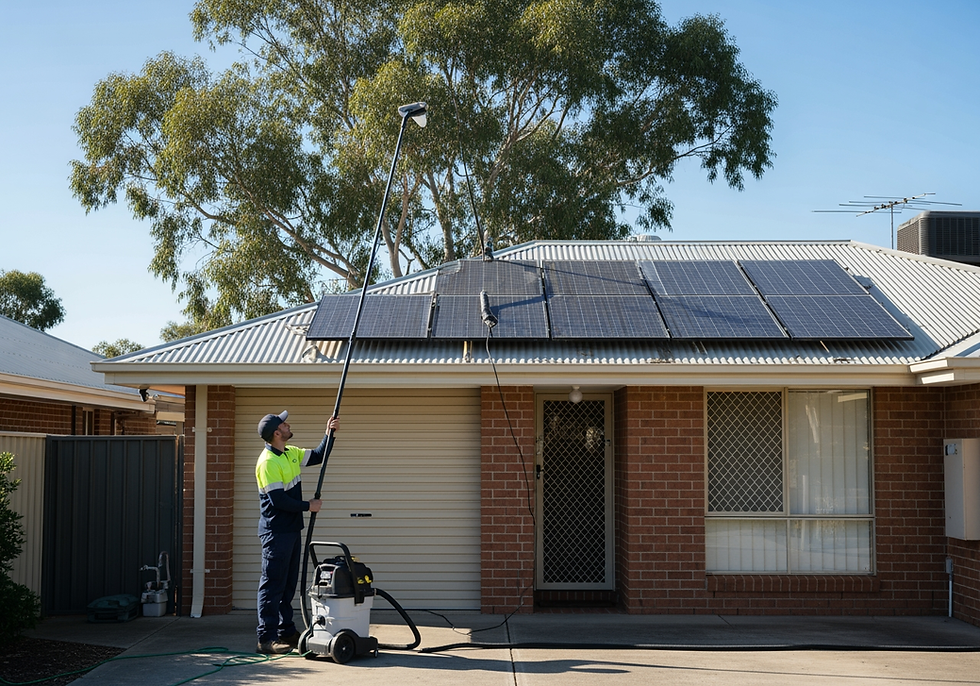
Professional solar panel cleaning uses purified water combined with purpose-designed soft-bristle tools that release bonded bird waste completely without scratching the anti-reflective coating - the step that restores full light transmission rather than simply removing the visible mess while leaving acid residue behind.
Dust, Airborne Particles, and Industrial Fallout
Perth's Dust Problem and Fine Particulate Accumulation
Perth's summer easterly winds carry fine red iron oxide particles from Western Australia's inland regions across the entire metropolitan area. These particles settle on every horizontal and angled surface - including solar panel glass - where they compact progressively through dry months into a layer that measurably reduces light transmission even when it appears thin from ground level.
Construction activity across Perth's expanding outer suburbs generates cement dust, silica particles, and construction debris that travels into established residential areas. Even a thin, uniform dust layer across a panel surface creates consistent light scattering that reduces output progressively across months of accumulation.
Industrial and Coastal Contamination Zones
Perth properties near the Kwinana and Rockingham industrial corridor face additional airborne contamination from manufacturing emissions, vehicle exhaust, and port activities. These produce metallic particles, chemical residues, and oil-containing compounds that create a film on panel surfaces resistant to water removal alone.
Coastal properties within five kilometres of the Indian Ocean face salt-laden air year-round. Salt particles combine with moisture from morning dew and coastal air to form stubborn deposits that bond with other contamination types. Salt also attacks aluminium panel frames and electrical connection points, making regular solar panel contamination Perth coastal properties need to address particularly important for both efficiency and long-term equipment integrity.
Maintaining clear gutters reduces one secondary contamination pathway for panel surfaces. Debris-blocked gutters overflow during Perth's winter rains, washing organic material onto lower roof sections and across panel arrays positioned near gutterlines. Professional gutter cleaning Perth removes the blockages that contribute this ongoing contamination source - and for properties with solar arrays, it is often worth scheduling alongside solar panel maintenance.
Pollen, Organic Matter, and Biological Growth
Pollen on Solar Panels - Perth's Spring Contamination Problem
Perth's native vegetation produces abundant pollen during spring and early summer. Eucalyptus, wattle, and banksia trees release fine pollen that adheres strongly to solar panel glass. Pollen on solar panels Perth homeowners often mistake for general dust, but pollen behaves differently and requires specific removal technique.
The organic compounds in wattle and eucalyptus pollen combine with morning dew to create a sticky coating that resists rain washing. Pollen on solar panels Perth installations accumulate through spring builds into a yellow-green film that can reduce light transmission across the full panel surface rather than creating localised shading spots. Left across multiple seasons, pollen's organic compounds begin etching into panel coatings - a slower but cumulatively significant damage mechanism.
Lichen, Moss, and Algae on Solar Panels
Lichen on solar panels represents the most tenacious biological contamination Perth installations face. Lichen establishes at panel edges and frame junctions where moisture accumulates, then spreads progressively across the glass surface as the organism grows. It bonds to glass through root-like structures that water pressure cannot dislodge - removal requires specific biocidal treatment followed by careful mechanical clearing.
Moss develops in shaded panel sections and around mounting hardware during Perth's winter months. Properties with significant tree coverage or south-facing panel sections experience more moss accumulation. Algae forms a slippery green biofilm on partially shaded panels exposed to regular moisture - creating both a light transmission barrier and a surface hazard for any maintenance personnel requiring panel access.
Professional solar panel cleaning removes these biological contaminants using appropriate solutions that address growth at root level, preventing rapid regrowth and extending the interval between required service visits. Proflo's pressure washing services apply the same evidence-based biological contamination approach across all exterior surfaces, adapted specifically for solar panel glass requirements.
Salt Spray, Hard Water, and Mineral Deposits
Coastal Salt Exposure and Its Effect on Panel Surfaces
Properties within five kilometres of Perth's coastline face constant salt particle settlement from Indian Ocean winds. These microscopic salt particles settle across panel surfaces continuously, where they attract atmospheric moisture in a wet-dry cycle that creates growing deposits of bonded mineral contamination. Salt bonding with bird waste, pollen, and dust produces compound deposits that are significantly more difficult to remove than any single contamination type alone.
Salt also attacks the aluminium frames and electrical connection points of solar panel systems directly. Corrosion at frame edges and connection points reduces system reliability and can create long-term electrical issues well beyond the surface efficiency losses that salt deposits cause directly.
Hard Water Stains From Sprinkler Overspray and Improper Cleaning
Perth's hard water creates white mineral spots wherever it dries on panel glass. Calcium, magnesium, and dissolved mineral content in Perth's reticulated water supply leave visible deposits after every evaporation. Garden sprinkler overspray affecting panels - particularly on lower roof sections and ground-mounted installations - deposits successive layers of mineral film with each irrigation cycle.
Solar panel dust removal attempts using standard garden hose water often replace one efficiency problem with another. Removing visible dust while depositing a mineral film across the panel surface produces partial cleaning that can be as counterproductive as not cleaning at all. Professional purified water systems contain no dissolved minerals, leaving panels completely clean as water evaporates.
Smoke, Fire Ash, and Construction Debris
Bushfire Smoke and Carbon Deposits on Perth Panels
Perth's bushfire season runs from December through March, producing smoke that carries fine carbon particles across the metropolitan area during significant fire events. This ash and carbon contamination settles on solar panels and creates a dark film that absorbs rather than transmits light. Smoke residue resists rain washing because carbon particles bond to glass surfaces and the chemical compounds in smoke contamination have adhesive properties that standard water cannot overcome.
Properties in Perth's eastern, southeastern, and southern suburbs near bushland-interface zones face this risk most acutely. Post-fire professional solar panel cleaning Perth restoration clears carbon deposits and inspects for any heat-related damage from ember contact - a specific Perth seasonal consideration that coastal Australian cities do not face at the same frequency.
Construction Dust and Renovation Debris
Building activity near solar installations - whether in adjacent properties or on the home itself - creates heavy contamination events. Cement dust, plaster particles, and construction debris bond to panel glass when exposed to morning dew or light rainfall. Property owners frequently overlook solar panel contamination Perth renovation activity causes until energy monitoring reveals unexplained production drops weeks after building work is complete.
Commercial cleaning services for Perth's schools, shopping centres, and strata complexes with rooftop solar installations include post-construction cleaning programs that address the specific contamination profiles that building activity creates on large commercial arrays.
How Contamination Types Compound Perth Panel Efficiency Losses
Individual vs Combined Contamination Impact
Each contamination type discussed above reduces solar panel output independently. The real efficiency cost of unaddressed Perth panel contamination, however, comes from the way these types interact and compound. Salt deposits attract and bind bird waste. Pollen's adhesive compounds glue dust particles to the glass surface. Lichen establishes in moisture trapped by leaf debris around mounting edges. Algae grows in positions where organic contamination creates nutrient availability.
The combined contamination that builds across a Perth solar panel between professional cleaning visits produces efficiency losses greater than the sum of individual contaminant impacts. Solar panel cleaning Perth professionals removing all contamination types simultaneously - rather than addressing one while leaving others - delivers the complete efficiency restoration that partial or DIY cleaning cannot achieve.
Cleaning Frequency Recommendations by Perth Property Type
Most Perth residential installations benefit from professional solar panel cleaning Perth twice yearly - October or November before summer peak production, and April or May after winter organic accumulation. Coastal properties within five kilometres of the ocean and those near Perth's industrial corridor in Kwinana and Rockingham benefit from quarterly cleaning to address the accelerated contamination rates their locations produce.
Post-bushfire emergency cleaning is a specific Perth seasonal consideration. Significant smoke contamination events can reduce output immediately and should be addressed professionally rather than waited out until the next scheduled service. You can see the before-and-after results of professional solar panel and exterior cleaning across a range of Perth properties in Proflo's project gallery.
Conclusion
Perth solar panels accumulate contamination from more sources, at higher rates, and with more bonding strength than panels in most other Australian cities. Bird waste, eucalyptus and wattle pollen, coastal salt deposits, industrial fallout, hard water minerals, bushfire ash, and biological growth each reduce output through distinct mechanisms - and interact with each other to create compound efficiency losses that standard rain and garden hose cleaning cannot address.
Professional solar panel cleaning Perth services using purified water, specialist soft-bristle tools, and appropriate biological and chemical treatments remove all contamination types simultaneously - restoring the full output that Perth's abundant sunshine should be delivering to your system year-round. Scheduling gutter cleaning Perth alongside solar panel maintenance addresses multiple contamination pathways in a single visit, particularly for properties where debris overflow contributes to panel fouling.
To arrange professional solar panel cleaning tailored to your property's specific contamination profile, contact ProFlo's solar panel cleaning specialists or email us at greg@proflowa.com.au for a free assessment and quote.

Comments