Common Area Maintenance Budgeting for Perth Strata Schemes
- Mar 19
- 8 min read

Perth strata schemes face a constant challenge: balancing adequate maintenance with affordable levies. Underfund common area upkeep, and properties deteriorate rapidly. Overspend, and owners revolt at levy meetings. The difference between well-maintained schemes and struggling ones often comes down to realistic budgeting backed by accurate cost data for strata maintenance costs Perth properties actually incur.
Most strata committees underestimate maintenance costs by 20-30% in their first budget cycle. This creates a cascade of problems including deferred maintenance, special levies, and owner dissatisfaction. Understanding actual costs helps committees plan effectively and avoid financial surprises.
Understanding Core Strata Maintenance Costs
Three Distinct Budget Categories
Common area maintenance splits into three distinct categories, each requiring separate budget allocation. Understanding these categories supports effective sinking fund optimisation.
Routine maintenance covers scheduled services performed monthly, quarterly, or annually. This includes gutter cleaning services, pressure washing, garden maintenance, and pool servicing. These costs remain relatively predictable year-over-year, though Perth's climate creates seasonal variations.
Preventative Maintenance: The Smart Investment
Preventative maintenance addresses wear before it becomes damage. Resealing driveways, cleaning solar panels, treating timber, and maintaining drainage systems fall into this category. These expenses prevent costly repairs but often get cut when budgets tighten, a false economy that increases long-term costs and reactive repair expenses.
Reactive Maintenance: Emergency Budget Allocation
Reactive maintenance handles unexpected issues: storm damage, plumbing failures, or urgent safety repairs. Even well-maintained schemes need a reactive budget allocation of 15-20% of total maintenance spending to cover reactive repair expenses when they occur.
Perth schemes typically allocate 60% to routine maintenance, 25% to preventative work, and 15% to reactive issues. Schemes that reverse these priorities, cutting preventative maintenance to fund reactive repairs, spend 40% more over five-year periods.
Calculating Realistic Gutter Maintenance Costs
Frequency Requirements for Perth Properties
Gutter maintenance represents one of the largest line items in strata budgets, yet committees frequently underestimate both frequency requirements and actual strata maintenance costs Perth properties incur.
A typical Perth strata scheme with 20 units requires gutter cleaning 2-3 times annually. Properties near established trees need quarterly cleaning, particularly during autumn when leaf drop peaks. Coastal schemes face additional challenges from salt buildup and sand accumulation.
Professional Service Cost Breakdown
Professional vacuum gutter cleaning costs $150-$300 per unit annually for schemes with standard two-storey buildings. Three-storey complexes with difficult roof access cost $220-$400 per unit. These figures include downpipe flushing and basic gutter inspection.
Budget allocation should account for:
Standard cleaning: 2-3 services annually at $80-$120 per service per unit
Storm response: Additional cleaning after severe weather events (budget 1-2 extra services)
Blockage clearing: Emergency callouts for overflowing gutters ($150-$250 per incident)
Minor repairs: Gutter bracket replacement, downpipe reattachment ($200-$500 annually)
Annual Budget Recommendations
A 20-unit scheme should budget $3,000-$6,000 annually for comprehensive gutter maintenance. Schemes that budget below $2,500 typically defer services, leading to reactive repair expenses of $8,000-$15,000 in water damage repairs within 2-3 years.
Pressure Washing and Surface Maintenance
Surface Deterioration in Perth's Climate
Exterior surfaces deteriorate rapidly in Perth's climate. Summer UV exposure, winter rain, and year-round dust create maintenance demands that many schemes underestimate.
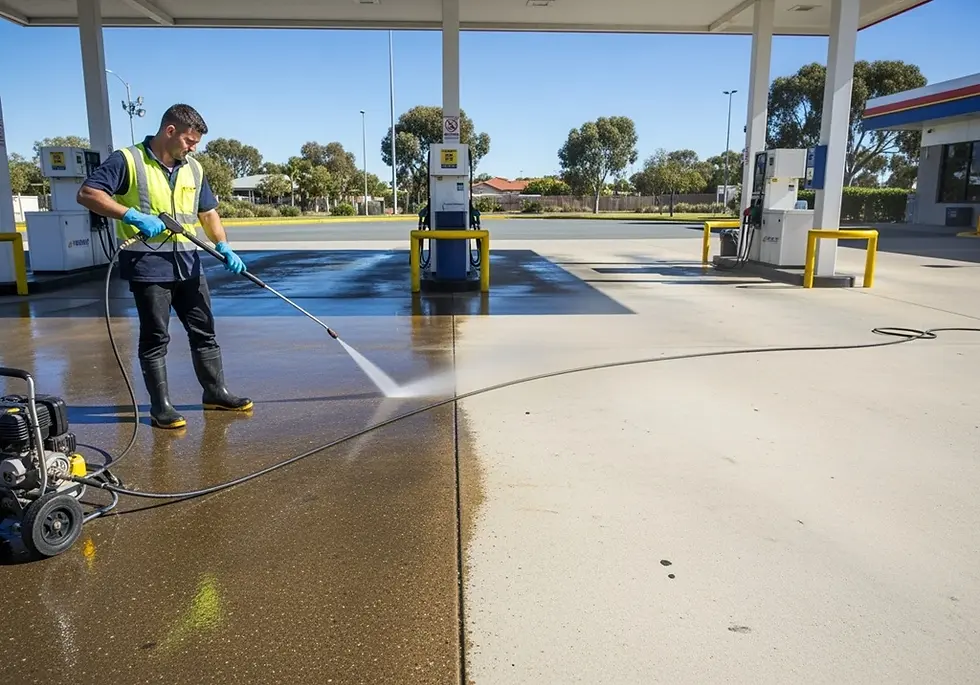
Pressure washing services should cover driveways, pathways, car parks, building exteriors, and entertainment areas. Frequency depends on surface type and exposure:
Concrete and Paver Maintenance Requirements
Concrete and paver driveways require annual high-pressure cleaning to remove oil stains, tyre marks, and organic growth. Budget $400-$800 for a standard 20-unit scheme car park. Schemes near industrial areas or busy roads need bi-annual cleaning.
Pathways and common walkways need quarterly cleaning in high-traffic areas, bi-annual cleaning for standard use. Slippery algae growth creates liability issues, making this maintenance non-negotiable. Budget $150-$300 per quarterly service.
Building Exterior Cleaning Costs
Building exteriors benefit from annual pressure washing, particularly rendered walls, painted surfaces, and areas under eaves where cobwebs and dirt accumulate. A standard two-storey complex costs $800-$1,500 for complete exterior cleaning.
Pool surrounds and entertainment areas require monthly cleaning during summer, quarterly during cooler months. Budget $120-$200 per service depending on area size.
Total Annual Pressure Washing Budget
Total annual pressure washing costs for a 20-unit scheme typically range from $2,500-$5,000. Schemes that defer this maintenance face accelerated deterioration, with rendered walls requiring repainting 3-4 years earlier, pavers needing replacement rather than cleaning, and concrete developing permanent staining.
Solar Panel Maintenance Budgeting
Efficiency Loss Without Regular Cleaning
Many Perth strata schemes installed solar systems in the past decade to reduce common area electricity costs. These systems require regular maintenance to maintain efficiency, yet most strata budgets allocate nothing for solar panel cleaning.
Dirty solar panels lose 15-25% efficiency in Perth's dusty environment. Schemes near main roads, industrial areas, or during construction phases experience faster efficiency loss. A 20kW system losing 20% efficiency costs the scheme $600-$1,200 annually in lost generation, far more than cleaning costs.
Service Frequency and Cost Structure
Professional solar panel cleaning costs $150-$300 per service for standard residential installations. Commercial-scale systems on larger complexes cost $300-$600 per service. Bi-annual cleaning maintains optimal efficiency for most Perth locations. High-dust environments benefit from quarterly cleaning.
Budget Allocation and ROI
Budget $300-$600 annually for residential-scale solar systems, $600-$1,200 for commercial installations. Include a contingency for post-storm cleaning if panels accumulate debris.
Return on investment is immediate. A $400 annual cleaning expense that prevents $800 in lost generation pays for itself while maintaining system longevity. Panels cleaned regularly last 25+ years at optimal efficiency; neglected systems degrade faster and require earlier replacement.
Commercial Property Maintenance Considerations
Mixed-Use Property Requirements
Strata schemes with commercial tenancies face additional maintenance requirements and higher costs. Ground-floor retail, medical suites, or office spaces create specific maintenance demands that residential-only budgets do not account for.
Commercial cleaning services for common areas near retail tenancies require more frequent attention. Increased foot traffic, delivery access, and customer parking create accelerated wear. Budget 40-60% more for pressure washing and general maintenance in mixed-use schemes compared to residential-only properties.
Commercial-Specific Maintenance Issues
Commercial tenancies also generate specific maintenance issues:
Grease and oil accumulation near food businesses requires specialised cleaning
Increased bin area maintenance from commercial waste volumes
Signage and lighting maintenance creates additional electrical and structural work
Loading dock maintenance for delivery access areas
Mixed-use schemes should allocate separate commercial maintenance budgets rather than averaging costs across all lots. This prevents residential owners subsidising commercial tenant impacts while ensuring adequate maintenance funding.
Seasonal Budget Variations
Understanding Perth's Maintenance Cycles
Perth's distinct seasons create predictable maintenance cost fluctuations that impact strata maintenance costs Perth schemes experience. Budgets that assume equal quarterly spending inevitably run short during high-demand periods. Understanding seasonal budget variations enables better planning.
Autumn (March-May): Peak Gutter Demand
Autumn brings peak gutter cleaning demand as deciduous trees drop leaves. Budget 35-40% of annual gutter maintenance costs for this quarter within your seasonal budget variations planning. Schemes near eucalyptus trees experience year-round leaf drop but still see increased accumulation during autumn.
Winter (June-August): Storm Response Capacity
Winter requires storm response capacity. Heavy rainfall exposes drainage issues, blocked gutters overflow, and pressure washing demand drops. Allocate 20-25% of annual gutter budget for winter maintenance and storm response.
Spring (September-November): Optimal Maintenance Window
Spring is optimal for preventative maintenance. Mild weather allows efficient completion of pressure washing, exterior painting, and building maintenance. Schedule 40-50% of annual pressure washing during spring months.
Summer (December-February): Solar and Pool Focus
Summer creates solar panel efficiency losses from dust accumulation. Schedule mid-summer solar cleaning and increase pool area maintenance frequency. Budget 30-35% of annual solar maintenance for summer months.
Committees that plan quarterly budget releases aligned with seasonal budget variations avoid cash flow problems and ensure timely maintenance completion.
Building Realistic Contingency Reserves
Industry Standards for Reserve Funds
Every strata scheme needs maintenance contingency reserves beyond the standard sinking fund. Unexpected issues arise regardless of preventative maintenance quality. Proper contingency reserve planning protects scheme finances.
Industry standards recommend maintaining liquid reserves equal to 3-6 months of standard maintenance costs through contingency reserve planning. For a scheme spending $15,000 annually on routine maintenance, this means $3,750-$7,500 in accessible contingency funds.
What Contingency Reserves Cover
These reserves cover:
Emergency repairs requiring immediate attention for safety or property protection
Storm damage response beyond insurance excess amounts
Urgent pest control for termite discoveries or bee swarm removal
Unexpected compliance requirements from local authority orders
Building Reserves Gradually
Schemes without adequate contingency reserves face two poor options when emergencies arise: defer necessary repairs or levy special assessments. Both damage property values and owner satisfaction.
Build contingency reserves by allocating 10-15% of quarterly levies to a separate maintenance reserve account as part of contingency reserve planning. This gradual approach avoids large special levies while creating financial resilience.
Getting Accurate Quotes and Comparing Costs
Request Itemised Quote Breakdowns
Strata committees often make budgeting errors by accepting the first quote received or selecting the cheapest option without understanding scope differences.
Request itemised quotes that separate:
Access costs: Scaffolding, elevated work platforms, or specialised equipment
Labour hours: Actual cleaning time versus travel and setup
Materials and disposal: Cleaning solutions, waste removal, water usage
Frequency discounts: Annual contract rates versus one-off service pricing
Compare on Per-Unit Basis
Compare quotes on a per-unit or per-square-metre basis rather than total cost. A $2,400 quote for a 20-unit scheme ($120 per unit) might be better value than a $2,000 quote for a 15-unit scheme ($133 per unit) even though the total is higher.
Understanding Price Variations
Question significant price variations. Quotes varying by more than 30% for identical scope typically indicate:
Different service standards (basic cleaning versus thorough maintenance)
Insurance and certification differences affecting liability coverage
Equipment quality impacting results and property safety
Hidden exclusions in cheaper quotes
Long-Term Maintenance Planning
Five-Year Maintenance Plans
Effective strata maintenance budgeting extends beyond annual cycles. Five-year maintenance plans identify upcoming major works and allow gradual reserve building rather than sudden special levies through proper sinking fund optimisation.
Create a maintenance schedule identifying:
Year 1-2: Routine and preventative maintenance at current service levels
Year 3: Anticipated major works (driveway resealing, exterior repainting)
Year 4-5: Equipment replacement (pressure systems, solar inverters)
Benefits of Forward Planning
This forward planning reveals funding gaps early. A scheme discovering it needs $30,000 for driveway resealing in 18 months can increase levies gradually rather than imposing a $1,500 per unit special levy. Effective sinking fund optimisation prevents these financial shocks.
Maintenance Extends Asset Life
Regular maintenance extends asset life and reduces long-term reactive repair expenses. Gutters cleaned consistently last 25-30 years; neglected gutters require replacement after 15-20 years. Pressure-washed driveways last 20+ years; neglected surfaces need replacement after 12-15 years.
The difference between proactive and reactive maintenance compounds over time. Schemes investing in consistent preventative maintenance spend 35-45% less over 10-year periods compared to schemes deferring maintenance until failures occur.
Conclusion
Proflo has worked with Perth strata schemes for 33+ years, helping committees develop realistic maintenance budgets that protect property values without imposing unexpected special levies. This guide provides detailed cost breakdowns based on decades of Perth strata maintenance experience.
Realistic strata maintenance budgeting starts with accurate cost data for Perth's specific climate and property conditions. Understanding actual strata maintenance costs Perth schemes face helps committees plan effectively. Committees that understand actual service costs, seasonal budget variations, and long-term maintenance requirements create budgets that maintain property values without imposing unexpected special levies.
Allocate 60% of maintenance budgets to routine services, 25% to preventative maintenance, and 15% to reactive repairs. Build contingency reserves through proper contingency reserve planning equal to 3-6 months of standard maintenance costs. Plan maintenance schedules around Perth's seasonal patterns and use sinking fund optimisation to ensure adequate long-term funding.
Well-maintained schemes with realistic budgets attract buyers, retain tenants, and preserve property values. The alternative of deferred maintenance and emergency reactive repair expenses costs significantly more while creating owner dissatisfaction and declining property appeal.
For detailed maintenance budgeting guidance specific to your strata scheme's needs, contact the experienced team to discuss comprehensive exterior maintenance solutions developed over 33+ years of serving Perth properties.


Comments